|
Residents whose homes were internally flooded and businesses who were affected by flooding as a result of Storm Henk in January can now formally apply for financial support in South Oxfordshire and the Vale of White Horse.
They might also be eligible for support if the flooding meant they had to leave their home or close their business for a period of 48 hours or more. The money comes from government funding schemes, which the local district councils are administering. There are a range of possible options, ranging from grants to discounts on council tax or business rates. There is more information on the district councils’ websites, where affected residents and businesses will also find a link to the relevant application forms: Eligibility criteria apply to all of these support options, so anybody who believes they are entitled to funding should read the details carefully before applying. Anybody who wants to receive support must apply using the links above. If they do not do so before the deadline, the councils will not be able to provide them with financial support. The deadline for all applications is 1pm on Monday 18 March, and any flooding events also need to have been reported via the Oxfordshire Flooding Report form. Anybody having difficulty applying or who requires support to do so, should contact [email protected] or 01235 422600 (option 3) during office hours. Any queries about the business support should go to [email protected] South Oxfordshire and Vale of White Horse District Councils have set out plans to change the way their garden waste service is paid for in 2025.
The councils’ have agreed the introduction of a permit scheme from April 2025 which will include subscribers receiving a sticker for their bins to identify them as fully paid-up garden waste customers. This kind of scheme is offered successfully by many other local authorities, including in neighbouring West Oxfordshire. When customers sign up and pay for the scheme in 2025, they will be sent a garden waste permit sticker to put on their bin/or bins, which will help the waste collection crews identify which bins should be emptied. The permits will act in a similar way to a parking permit as a proof of subscription payment. All subscribers will receive a new sticker annually each time they renew. This will help to ensure that only households that have paid for the service have their brown garden waste bins emptied. The changes are part of the councils’ ongoing work to improve the efficiency and value of public services. The garden waste subscriptions currently run via annual direct debit payments from the date people signed up for the scheme. Next year, the councils will stop taking direct debit payments for the service. Customers will instead make a single annual payment by debit or credit card - so that everyone’s payment year will run from 1 April to 31 March each year. The council will directly contact all customers, via letters and email, in plenty of time to remind them to renew. Benefits to customers include an all-new online system so they can manage their account and change their details much more easily. This will also mean the councils can contact people quickly if there are any disruptions to the service, such as during adverse weather. Current subscribers will receive notification of the changes with this year’s invoices. This will provide more information on the new system in 2025 as well as details of changes to their direct debit payment this year and the annual fee increase to cover the cost of running the service. Cllr Sue Cooper, South Oxfordshire District Council’s Cabinet Member for Environment, said: “We offer a garden waste service as we know over 31,500 households in South Oxfordshire value this optional service. It also contributes to our excellent recycling rates – where only this month, South Oxfordshire has been ranked as the top recycling district in England. “The new permit scheme will help enhance our service’s efficiency. The option for an online account should be easier for customers and will mean that you don’t need to contact us if your bank account or other details change. The new permit stickers will help us to make sure that only those who pay for the service actually get collections, which we think is only fair, since this is an opt-in service.” Cllr Mark Coleman, Vale of White Horse Cabinet Member for Environmental Services and Waste, said: “Our popular garden waste scheme currently serves nearly 28,000 households in the Vale. As with all council services, we regularly review what we offer and strive to make sure our service is the best it can be. I’m confident the new permit scheme, combined with introducing online customer accounts, will make our garden waste service even better for everyone. “We do appreciate that any changes to a major service can initially be challenging so we will make sure all our customers are contacted and fully informed on all changes that are coming now and from April 2025. There is also a FAQ on our website with further detailed information.” An FAQ covering all the changes is available on our garden waste section: South FAQ / Vale FAQ. The councils’ customer services team will also be on hand to assist with any queries customers have. Residents in South Oxfordshire were officially ranked the best recyclers in the country, with residents in the Vale a close third, according to a government league table published in early February. As of November 2023, there were around 59,300 live accounts (31,500 South and 27,800 Vale). Some properties have more than one bin, so this equates to around 66,300 bins (South 36,000 Vale 30,300). View the recent garden waste report to Cabinet: South (Item 7) / Vale (item 9). 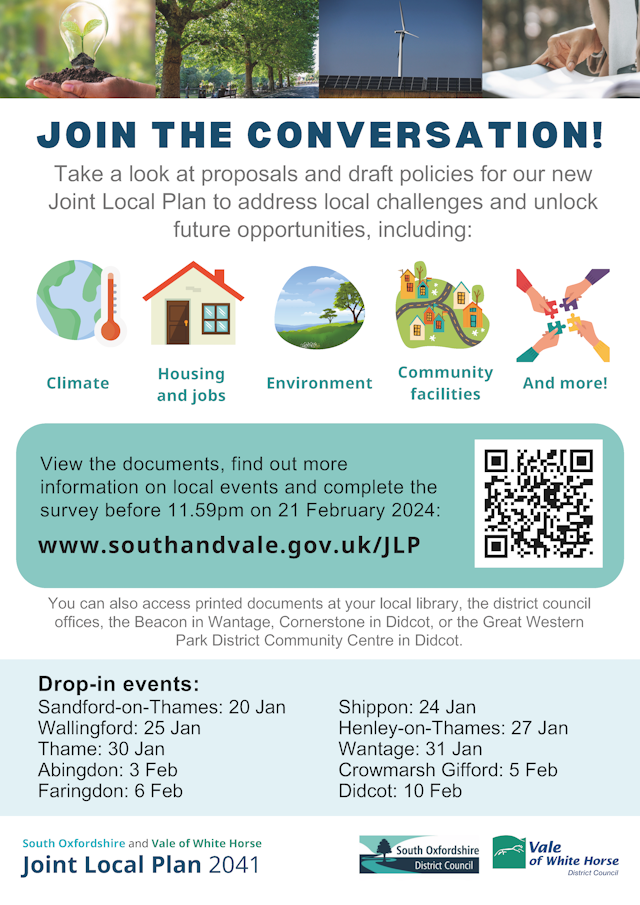 Building our tomorrow together – join the conversation to help shape the future of our districts
Requiring sustainable development; protecting and enhancing our countryside; setting higher energy efficiency standards for new buildings; and prioritising more sustainable transport options – these are all benefits planned for South Oxfordshire and the Vale of White Horse, and everyone is being invited to join the conversation. Innovative draft policies to address local challenges and unlock future opportunities across the two districts have been published for community feedback, as part of the councils’ work to deliver their Joint Local Plan 2041. The six-week consultation launches today 10 January and will run until 11.59pm on 21 February 2024. Visit southandvale.gov.uk/JLP to find out more and have your say. Among many topics the Joint Local Plan covers are some updated, new and innovative approaches such as:
The two councils are working together to deliver the Joint Local Plan, which will set out what development should be allowed and where, help guide decision-making for planning applications, and set standards for environmental protection, sustainability, water quality and much more, for the years until 2041. Councillor Anne-Marie Simpson, Cabinet Member for Planning at South Oxfordshire District Council, said: “The Joint Local Plan is one of the most important documents we deliver as a council and has a lasting impact on our community. That’s why we need everyone across the districts to join the conversation and actively participate in this process to help shape our future. “We had a great response to our first Joint Local Plan consultation, so I’m excited to share our proposed approaches with the community, highlight how your previous feedback has shaped our work, and showcase our plans to benefit our community, economy, and environment." Councillor Andy Foulsham, Cabinet Member for Corporate Services, Policy and Programmes at Vale of White Horse District Council, said: “Using your previous feedback and a range of new research, we’ve developed these innovative policies to take action on your most important priorities, like protecting our countryside and climate action. “A local plan takes years to develop and so it’s important we regularly check in with residents and local businesses throughout the process to make sure we’re delivering a Plan that truly represents our community. We really welcome comments on what our Joint Local Plan to 2041 should contain.” Using the interactive online hub, users can navigate through the Joint Local Plan topics that matter most to them; view proposed approaches, draft policies and supporting evidence documents, and explore interactive maps to see site allocations, where policies apply and more. There are two ways for people to share their feedback online depending on how much detail they want to get into:
The councils will also be out and about across the districts during January and February, with a host of local events. People can come and find out more about the plan, chat with council officers and members, ask questions and find out how to give feedback. There will also be paper copies of consultation documents around the districts’ libraries, as well as at Abbey House, Abingdon, the Beacon, Wantage, and Cornerstone Arts Centre and Great Western Park District Neighbourhood Community Centre in Didcot, giving residents less comfortable with the internet the chance to take part as well. Councillor Simpson said: “We want to make it as easy as possible for you to share your thoughts, so whether you prefer online or print, we can’t wait to hear your views.” Councillor Andy Foulsham added: “We also encourage you to share the consultation with your friends, family, and neighbours to spread the word and get as many voices as possible to join the conversation.” In-person events: Drop in to one of our in-person events to chat with us, ask questions and join the conversation. Find out more on the consultation webpage: The proposed development at Wicklesham Quarry is a county matter by virtue of paragraph 1(1)(h) of Schedule 1 of the Town and Country Planning Act 1990 as amended, as the site is in its aftercare period on the previous mineral permission. It is now for the prospective applicant to submit a planning application for their proposed development to the County Council for determination. They have not yet done so although they have sought pre-application advice. As part of the pre-application stage the applicant sought an Environmental Impact Assessment (EIA) Screening Opinion under the provisions of the Environmental Impact Assessment Regulations.
Having assessed the information submitted, the County Council determined that the proposed development would not be EIA development. Based on the information presented, the County Council determined the impacts that would arise would be localised to the site and immediate surrounds and therefore not at a scale that requires an EIA process to be undertaken. This included assessment of information provided by the applicant that set out how impacts on the geological SSSI would be mitigated. The Vale of White Horse also reached the same decision that the proposal would not be EIA development when they dealt with a previous screening opinion request from the applicant when they had thought the proposal was a district rather than county matter. Anybody who disagrees with the Screening Opinion can seek a Screening Direction from the Secretary of State and so this would be recourse for any party who disagrees with the decisions by both the district and county councils on this matter. Whilst it has been determined the proposed development does not require EIA, environmental impacts will of course be rigorously assessed through any future planning application by the County Council’s planning team. The application would need to be accompanied by environmental information and subject to consultation with statutory environmental bodies as well as residents and other interested parties. The application information and consultation responses will then be assessed by the planning team and a recommendation made having weighed up all the considerations, including those concerned with the environmental impacts. The planning application process will also assess the proposal against all relevant development plan policy, which will include those contained in the County Council’s Minerals and Waste Core Strategy Part 1, the Vale of White Horse Local Plan and Faringdon Neighbourhood Plan. In summary, due process has been followed with the EIA screening process in respect of the proposed development at Wicklesham Quarry. The next step would be for a planning application to be submitted, which once received will be subject to statutory consultation and assessment against all relevant policies and material considerations that will include rigorous review of environmental and all other impacts. Please see attached proposed formal diversion of Footpath No.6 by OCC, onto the boardwalk/kissing gate already constructed by the National Trust. This diversion has been in use for some years, but this order would formalise the route.
|
Categories
All
Archives
March 2026
AuthorThis site is run by the parishioners of Great Coxwell for the benefit of everyone. Please submit information, ideas and comments so that the site can be developed to best effect. |
 RSS Feed